V3 draft / A

Tar works of the Tuchola Forest

Cross-section diagram of a kiln: three routes of the products of dry wood distillation General teaching diagram. A pale chamber with a sloping floor. At the top a narrow outlet, from which thin dashed lines of gas run upwards. In the middle of the chamber, a dark mass of solid residue. Along the lower edge a black band of liquid runs towards an outlet in the wall and into a vessel in the ground.
Teaching diagram — not a reconstruction of the Laski kiln. Light area: the wood charge. Dark mass: solid residue.

Choose the product's route

Explanation of the selected route

All three routes

Wood heated with limited access to air does not burn but breaks down. Volatile products go up, liquid ones run down, and the solid residue stays.

How to read the drawing
Choose one of the three routes. The others stay in the drawing, greyed out, so that the whole remains visible. The routes also differ in shape: dashes, solid masses, a black band.
What the drawing does not give
Temperatures, firing time or the proportions of the products. It is not instructions for running the process.
Assumptions of the diagram
A chamber with a sloping floor, a liquid outlet and a gas outlet. It is a general model for learning, not a description of the Laski kiln or of any specific kiln in the Tuchola Forest.
Not to be confused with a charcoal clamp
A charcoal clamp is a pile of wood covered with earth, in which the aim is charcoal. Liquid is not collected in it as a product. So charcoal alone, or a mound in the forest, does not say that a tar works stood here.
Gas · the route up

Volatile products of the breakdown of wood, flammable gases and vapours, rise towards the outlet at the top.

Route in the drawing
From the chamber through a narrow channel at the top to the outside. Thin dashed lines with arrows pointing up.
What it is (in general)
A mixture of gases and vapours. Some of the vapours may condense further on, in cooler places. We give neither the composition nor the quantities here.
Use in the Tuchola Forest
unverifiedThe V2 draft said that the gas escaped or helped to heat the kiln. This was not checked in this run.
Not to be confused with a charcoal clamp
In a charcoal clamp gases and vapours escape too, but the aim is charcoal. A trace of a fire or of burning therefore does not say which product was being made.

Solid · stays

What did not volatilise or condense stays in the chamber as charcoal.

Route in the drawing
It travels nowhere. In the drawing it is the dark mass in the middle of the chamber. After cooling it can be taken out (general description).
Use in the Tuchola Forest
unverifiedV2 gave smithing and smelting fuel. This too was not checked in this run.
Not to be confused with a charcoal clamp
In a charcoal clamp, charcoal is the main aim. In a tar works it is one of three results of the breakdown. Charcoal in the ground alone does not settle which process left it.

Liquid · the route down

Heavy, sticky products condense and run along the sloping floor towards the outlet.

Route in the drawing
Along the chamber floor, through an outlet in the wall, into a vessel in the ground. The black band and the slope of the floor are an assumption of the diagram.
What it is
to be confirmedWood tar and a watery condensate. V2 also mentioned acetic acid and turpentine; the composition must be checked in the source.
Use in the Tuchola Forest
unverifiedV2: sealing boats and barrels, impregnating foundation beams. This was not checked in this run.
Not to be confused with a charcoal clamp
Collecting the liquid requires a vessel, an outlet and a slope, that is, a structure. Dark soil or charcoal on the surface do not prove this by themselves.

Where the products went and what stands in the museum

The actual exhibit is a reconstruction of the Laski kiln in the Ethnographic Park in Toruń. This is what the museum description quoted in V2 says; it still has to be checked again in the source.

Uses according to the V2 draft — unverified
RouteUse according to V2
LiquidSealing boats and barrels, impregnating foundation beams.
SolidFuel, including for smithing.
GasEscaped or helped to heat the kiln.
Document missingA photograph of the exhibit or a drawing of the Laski kiln consulted with the museum was meant to be here.
There is no photograph here: we do not hold rights to a photograph of the exhibit or to a drawing consulted with the museum. The diagram above does not replace it.

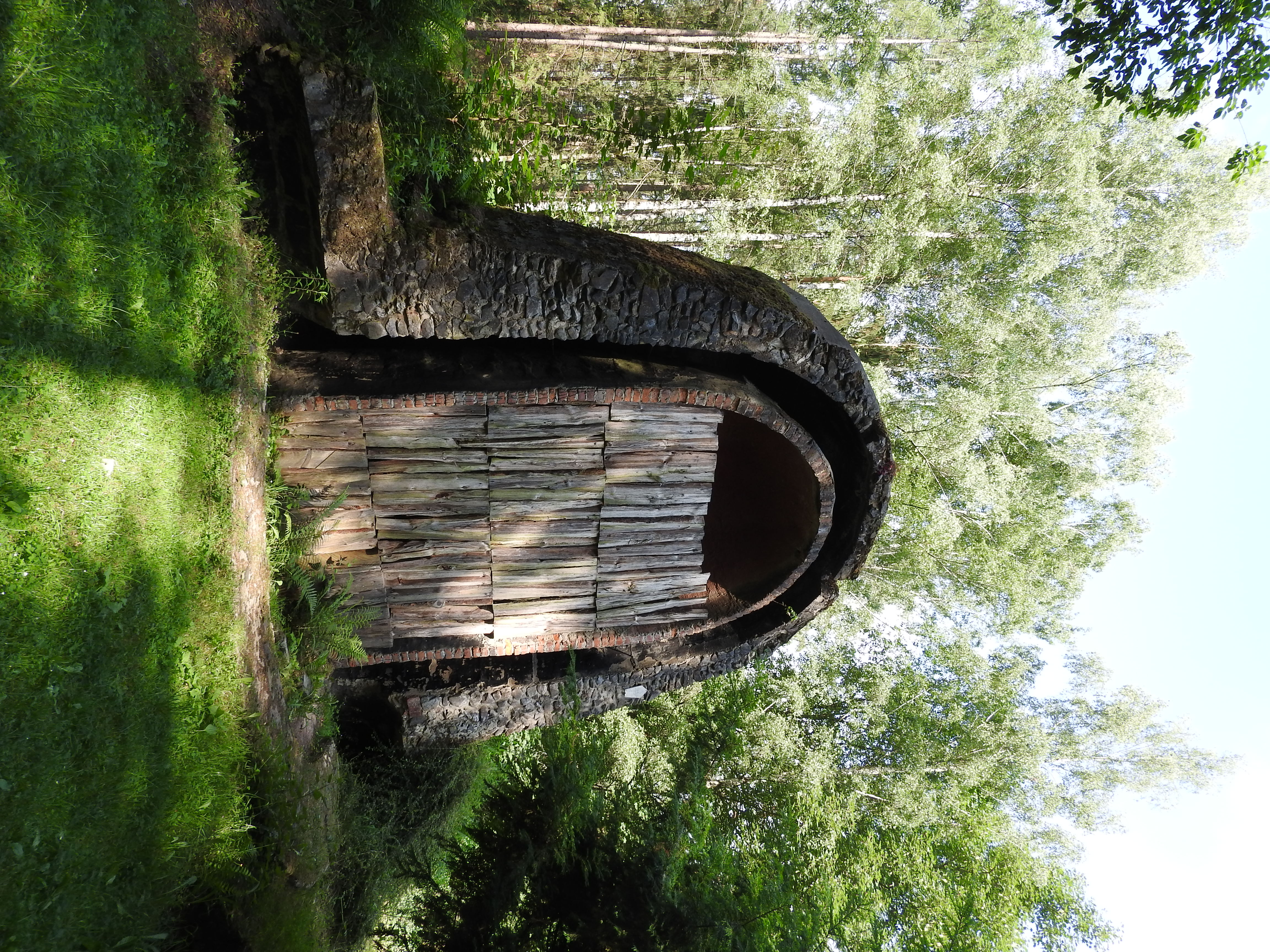
Foreign comparison: a brick tar kiln in Bobeck in Thuringia. The photograph is on Wikimedia Commons (author according to V2: Aschroet, CC0 — to be checked). It is not embedded here, and it does not illustrate the Tuchola Forest in any way. Photograph from Bobeck

The museum kiln and a trace in the forest

What may and may not be inferred
FeatureLaski exhibit (per V2)Field trace
Floor and liquid outletA brick-built chamber with a drain at the bottom. Check in the museum description what exactly has been preserved.A hollow or basin in the ground has many possible causes, for example a tree-throw pit or a charcoal clamp. Without investigation it is not a liquid outlet.
Black soil, charcoalNot applicable: it is a reconstruction.Charcoal and dark soil also form in charcoal clamps and campfires. They do not indicate the product.
Mentions in documentsNot applicable.V2 refers to mentions of tar kilns before 1632 (Dzięgiel, Giełdon). This must be checked in the source. A record in a document does not indicate the location of relics.

Conclusion: from features visible on the surface we do not derive an identification of a site. This page does not assess any place and does not calculate probability.

What is missing for any identification

  1. A photograph of the Laski exhibit with rights cleared, or a drawing consulted with the museum.
  2. A description of the construction of the Laski kiln from the museum source itself: whether it has a sloping floor, a liquid outlet, a gas outlet.
  3. A check in the literature of what was produced in the Tuchola Forest and how, and what the products were used for.
  4. A check of the archival mentions (Dzięgiel, Giełdon) and of what they actually say about the place.
  5. Field documentation and investigation carried out by qualified specialists. There is none on this page and nothing replaces it.

Sources for further verification

The sources were taken over from the V2 draft and were not opened in this run. Version V2 had a pending correction reported, so we treat its content as unverified. The drawing is a new teaching diagram, not historical evidence. In the forest you must not dig anything or enter strict protection zones; this page is not for finding sites.